Pocket Park or Plaza: Choosing a Place to Pause
Pocket park or plaza? Compare routes, shade, seating and upkeep to choose a public space that supports a comfortable pause without obstructing everyday movement.
A pocket park or plaza should answer a need already visible on its street: somewhere to rest, a clear route through, or room to meet. Begin with the people arriving from nearby doors, crossings and bus stops, then decide which parts of the site should invite a pause and which must stay open.
The distinction is not simply green space versus paving. Planting can make a seat feel sheltered; firm, level ground can make a route easier to follow. Like a doorway with a clear threshold, a small public space works when people can understand how to enter, move through and stop without getting in one another’s way.
Read the street edges
Look at the approaches before studying the centre. A strip between shops may carry people with bags past a doorway, while a forecourt beside a civic building may receive groups arriving together. Crossings, entrances and bus stops reveal where people come from and which lines of movement need to remain clear.
Visit at different ordinary times and notice where people already wait, sit or step aside. A short visit cannot show everyone who uses the site, or those who avoid it, so ask nearby residents, shop staff and workers what they need. Treat what you see as a starting point for discussion, not a complete account of local use.
Then decide whether the site should mainly offer a brief retreat or accommodate people moving and meeting. A small green corner may suit a quiet lunch; a civic forecourt may need open space for a group to gather. A good design can give one area priority for movement and another for a calmer pause, rather than forcing the whole site into one role.
Choose surfaces for use
Planting can offer shade, seasonal interest and a boundary from traffic. A tree near a bench may make sitting feel more comfortable, while a low planted edge can mark where feet should not cut through. Allow enough ground for the plants and keep routes broad and legible; greenery that narrows access or is repeatedly trampled does not serve either purpose well.
Firm paving can support wheeled movement and leave room for people to gather. But a broad, empty surface may feel exposed and provide no comfortable place to stop. Seats at the edge, a tree in a suitable planter or a sheltered boundary can add places to pause without placing obstacles in the main route.
Surface materials affect more than appearance. Smooth paving is generally easier for small wheels and canes than loose gravel, while planting beds require care and should not be treated as spare ground. Consider the route, drainage, weather and available maintenance together. Ask the responsible city team about local requirements where they apply.
Make access legible
Trace a continuous route from pavement into the space and past its main features. Keep it clear of bins, tree pits and café furniture, and check that someone can pass a seated visitor without being pushed towards the road or planting. Access should be apparent from the entrance, not dependent on knowing a hidden route.
Offer more than one kind of place to sit. A bench with a back and arms can help someone who needs support; a low wall or perch may suit a brief stop. Leave adjacent space for a wheelchair, mobility scooter or pushchair, rather than assuming every visitor will transfer onto a seat.
Consider who can see the seating and its approaches. A sheltered corner may feel comfortable, but dense screening can make it feel cut off. A sunny bench can be welcome in cool weather and uncomfortable in heat. Where space allows, provide a choice between a more social seat and a quieter one.
Plan shade and care
Planting needs a named route to maintenance. Before selecting trees or shrubs, consider the eventual canopy, roots, leaf fall and watering. Ask who will care for the beds and how that work can happen without disrupting the main route. If no one can maintain a planting scheme, choose a simpler arrangement that can still be cared for properly.
Shade can make a pause more comfortable for someone waiting, eating or supervising a child. Trees may take time to provide cover; a built canopy can provide shelter sooner but may affect sightlines and other activities. Check how sun and building shade fall across the site through the seasons, then place seats where people are likely to use them.
Wind and rain also shape a small space. Tall buildings can funnel gusts, while dense planting may leave a corner damp. A low wall or sheltered building edge can help without enclosing the space. The right response depends on the site, so check the proposed layout in place rather than relying only on a plan.
Which space fits the need?
What is a pocket park best for?
A pocket park suits a short retreat where planting, shade or separation from traffic would help. It can offer a quiet seat or a pause with a child, provided the route and seating remain accessible.
What is a plaza best for?
A plaza suits a site where people need firm, open ground to cross, meet or gather. Seats and shade at its edges can make the space comfortable without blocking its central route.
Can a small site do both?
Yes, if the layout protects a clear route while providing a quieter planted or shaded edge. Let the site’s approaches and everyday use determine where movement and rest belong.
What should be checked before choosing?
Check the routes people take, where they currently wait, whether seats are reachable, and who will maintain planting and furniture. Walk through the site with nearby users and revise any arrangement that blocks movement or leaves no comfortable place to pause.
Work through a layout
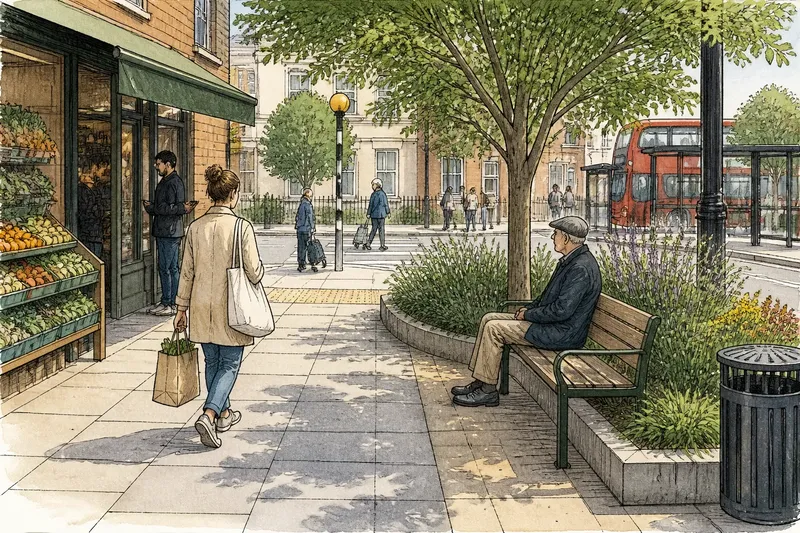
Imagine a hypothetical corner beside a grocer with a narrow planted strip, a doorway where customers wait, and no comfortable seat. Start by tracing the clear walking line from the crossing past the shop entrance. Ask nearby users where they wait and note that the doorway is already serving as an informal stopping place. Sketch a bench beside the planted edge, leaving the walking line and shop entrance clear, and add a level approach to the seat. The resulting decision is to favour a small planted pause rather than an open gathering area: the bench offers somewhere to wait, while the clear route keeps the corner passable. If the sketch cannot preserve that route, remove or relocate the bench instead of narrowing the way through.
- Observe whether people already stop in a doorway; if they do, provide a nearby waiting place that keeps the entrance clear, otherwise avoid adding a seat that serves no evident need.
- Observe whether the main route passes close to proposed furniture; if it does, move the furniture to an edge, otherwise retain the layout if the route remains clear.
- Observe whether a wheelchair or pushchair can reach the seating area; if not, revise the surface or route, otherwise keep the accessible approach.
- Observe whether the chosen surface feels firm and level along the route; if not, select a more suitable surface, otherwise retain it and check its upkeep needs.
- Observe whether planting would shade a seat or narrow the path; if it would narrow the path, reduce or relocate the planting, otherwise place it where it supports shade.
- Observe who will water and maintain the planting; if no responsible team can take it on, simplify the planting plan, otherwise confirm the care arrangement before proceeding.
- Observe whether a sheltered seat is visible from the approach; if it is screened off, adjust the planting or seat position, otherwise retain the sheltered option.
For a pocket park or plaza, the useful choice is the arrangement that lets people stop without making someone else’s route harder. A clear approach, a seat placed with care and a realistic maintenance plan matter more than whether a drawing gives the space a green or civic label.