How to Check a Neighbourhood Boundary for a Local Service
Check a neighbourhood boundary against the right council or service source, so you can identify the team responsible for a street without relying on a familiar place name.
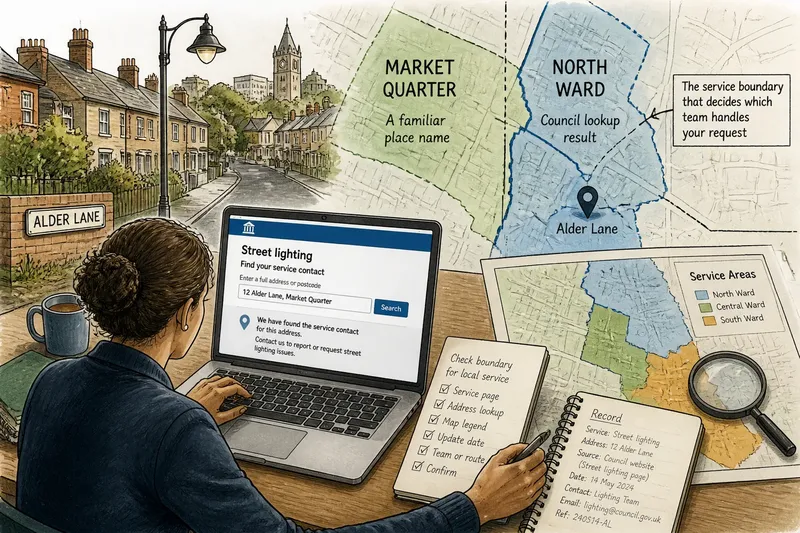
A neighbourhood boundary can put a familiar street in a different service area from the one residents name. To check a neighbourhood boundary for a local service, start with the organisation responsible for that service and the exact street or address, not the nearest landmark.
This approach keeps a local name useful without asking it to do administrative work. A place name can help you explain where you live; a service map or address lookup can identify which team handles a request. They answer different questions.
Identify the decision
First, be precise about what needs deciding. A request about a missed collection, a streetlight or a housing matter may go to different council teams, even at the same address. The relevant service’s own coverage information is more useful than a general map of neighbourhood names.
Find the official page for that service and note what its map or lookup actually returns. It may identify a ward, an operational patch or a responsible team. Those labels are not interchangeable, so use the one the service itself specifies.
If the page asks for a postcode, use it to locate the address, then confirm the result against the street or property details where possible. A postcode is a search aid, not proof that every nearby home shares the same service arrangements.
Read the boundary source
A map is only useful if you know what it represents. An electoral ward map can help identify representation, but it may not show the team responsible for a particular service. A council service page, by contrast, may give a street-level lookup or direct contact route.
Check the map’s title, legend, publisher and update information. Look for terms such as “service area”, “ward” or “coverage”; if the page does not explain them, ask the organisation what its boundary controls. Treat an old leaflet or a saved link cautiously if a current page is available.
Keep the question narrow. If the issue concerns a council service, a residents’ group’s map cannot settle responsibility. If it concerns whether a group includes your street, the council’s ward map cannot settle membership. Ask the body that makes the decision.
Check street-level coverage
When a boundary runs close to a road, do not infer coverage from which side looks nearer to a landmark. Search for the exact address or ask the service to confirm the street and, if necessary, the property. This is especially useful where a road, estate or new development sits close to an area edge.
If an online result names a broad area but not a team, contact the service through its published route. Give the street name and explain the task in plain terms. Ask which team handles that specific address and whether the listed boundary applies to the service you need.
Say you live on an invented street called Alder Lane, where neighbours use the name “Market Quarter”, but the council lookup returns “North Ward”. You need to report a faulty streetlight. You enter the address in the council’s street-lighting page; it returns a service contact but does not name a team. You send the address to that contact and ask who handles streetlights on Alder Lane. If the reply confirms the listed team, you use that route; if it redirects you, you keep the confirmation and contact the named team instead. “Market Quarter” remains a clear local description, but it does not decide the service route.
Resolve conflicting results?
Which boundary applies to my request?
Use the boundary published by the organisation responsible for the service, and check that the page refers to the specific task. If the source is unclear, give the organisation the street or address and ask it to confirm coverage.
Does a ward map identify the service team?
Not necessarily: a ward map identifies an electoral area, while a service may use a separate operational patch. Check the service page or ask the council which team handles the address.
What if two council pages disagree?
Check their dates and whether they cover the same service, then contact the department that handles the request. Ask which page applies to the address and retain the response with your service details.
Can I use a local place name on a form?
Use a place name only where the form asks for one or provides it as an option. For a service request, supply the street or address and follow the form’s own area fields.
Use a clear record
A short note can prevent the same uncertainty returning. Record the service, the address checked, the source consulted and the team or contact route confirmed. If the organisation later changes its information, you can check the current page rather than relying on memory.
Use a simple list to decide what to do next:
- Check whether the page names the service you need; if it does, use its coverage information, and if it does not, find the page for the correct service.
- Check whether the lookup accepts the full address; if it returns a street-level result, follow that route, and if it returns only a broad area, ask the service to confirm.
- Check whether the map legend defines the boundary; if it names a service patch, use it for that service, and if it names a ward, look for service-specific information instead.
- Check the page’s date or update note; if it appears current, proceed with the listed contact, and if it is old or undated, seek confirmation from the responsible organisation.
- Check whether the result identifies a team or only a general department; if it names a team, contact it, and if it does not, ask the department to route the request.
- Check whether two sources refer to the same task and address; if they agree, use the shared route, and if they conflict, ask the responsible service which applies.
A boundary can be like a label on a filing drawer: helpful only when it names the system that will handle what you put inside. For a local service, the most useful neighbourhood boundary is the one the responsible organisation currently applies to your street. A familiar landmark can still make your location easier to explain, but the address and service source should settle where the request goes.